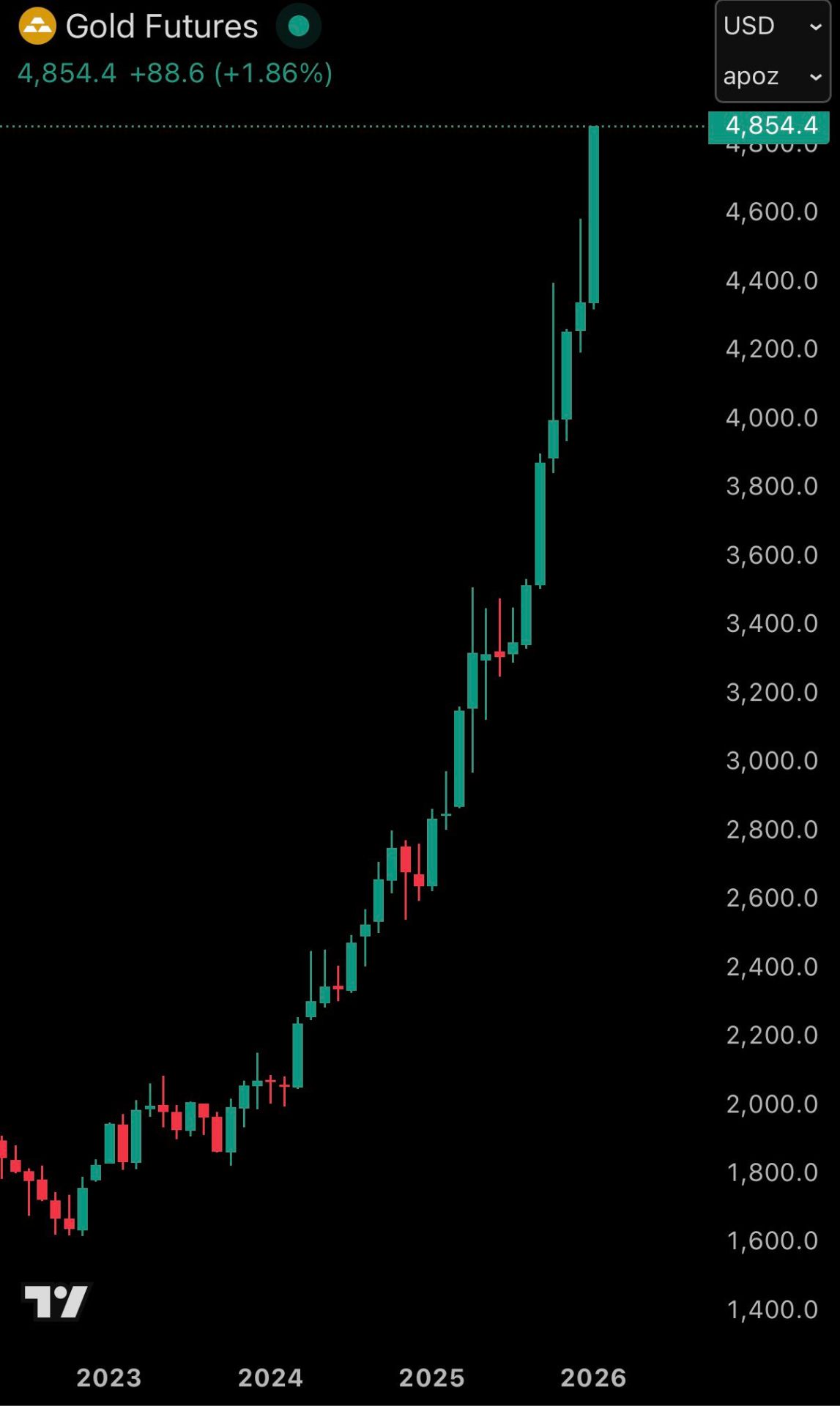
Gold has just shattered records to hit ~$4,850/oz, surging an unprecedented $260 within a 48-hour window. This vertical move isn't merely a reflection of bullish sentiment; it is a market referendum on the erosion of the global trust premium.
A Systemic Shock to the Macro Framework
In the traditional 2010–2020 market framework, a "risk-off" environment followed a predictable script: equities fell, yields dropped, and the US Dollar and Gold rose in tandem. However, the current regime is far more volatile. We are witnessing gold accelerate while confidence in traditional macro "anchors" begins to wobble.
When gold moves with this level of velocity, it is no longer chasing inflation data (CPI). Instead, it is pricing a massive credibility gap—the growing fear that international rules, alliances, and policy guardrails have become negotiable assets rather than fixed constants.
The Greenland Signal: Geopolitics as a Pricing Input
The geopolitical tension surrounding Greenland is serving as a critical pricing input for global markets. It represents a paradigm shift where transactional leverage is used over allies in ways previously unpriced by the market. As the probability distribution widens for NATO stress and the use of tariffs as geopolitical weapons, the risk premium on hard collateral rises proportionately.
For a deeper dive into how these shifts are impacting the broader landscape, see our analysis on the Greenland Geopolitical Shock and its influence on regime risk.
Redefining "Risk-Free" Assets
As the global order shifts from a rules-based system to one defined by leverage, capital is no longer treating government paper as a "default" safe setting. Instead, sovereign debt is being treated as a directional position that requires active risk management. This transition leads to:
- Heightened structural volatility across all asset classes.
- Frequent correlation breaks between bonds and equities.
- A structural bid for hard assets that exist outside the financial "plumbing."
The Mechanics of a Violent Move
Gold does not drift when a regime flips—it gaps. The current move has been intensified by a combination of CTA momentum, the liquidation of volatility sellers, and the triggering of large-scale stop-loss orders. This has transformed a standard price discovery phase into a massive liquidity squeeze. For a historical perspective on this type of movement, compare this to our Gold Price Forecast regarding hedge demand and real yields.
The $5,000 Psychological Magnet
In the current tape, round numbers like $5,000 act as gravity. These levels become focal points for hedging flows and discretionary positioning. Currently, the narrative is providing the market with the "permission" it needs to test these psychological barriers, and there are few fundamental reasons for the ascent to stop in the immediate term.
Cross-Asset Implications
The gold referendum is spilling over into the rest of the financial complex:
- Forex: The US Dollar is shifting from a standard safe haven to a political asset. Watch our USD/JPY Market Note to see how safe-haven bids are clashing with rate differentials.
- Commodities: Silver and industrial metals are also seeing a "high beta" response to gold's volatility. See the Silver Market Analysis on mean reversion risks for more context.
- Equities: Expect massive dispersion as the market rotates toward company balance sheets with high certainty, clipping crowded growth stocks.
Conclusion: A Real-Time Regime Shift
Gold at $4,850 is the symptom; the underlying cause is a market paying for insurance because it no longer trusts a smooth baseline for the global economy. This is not event-driven volatility; it is structural. Investors must adapt to a reality where the geopolitical order is wobbly, and the cost of protection reflects a world in transition.