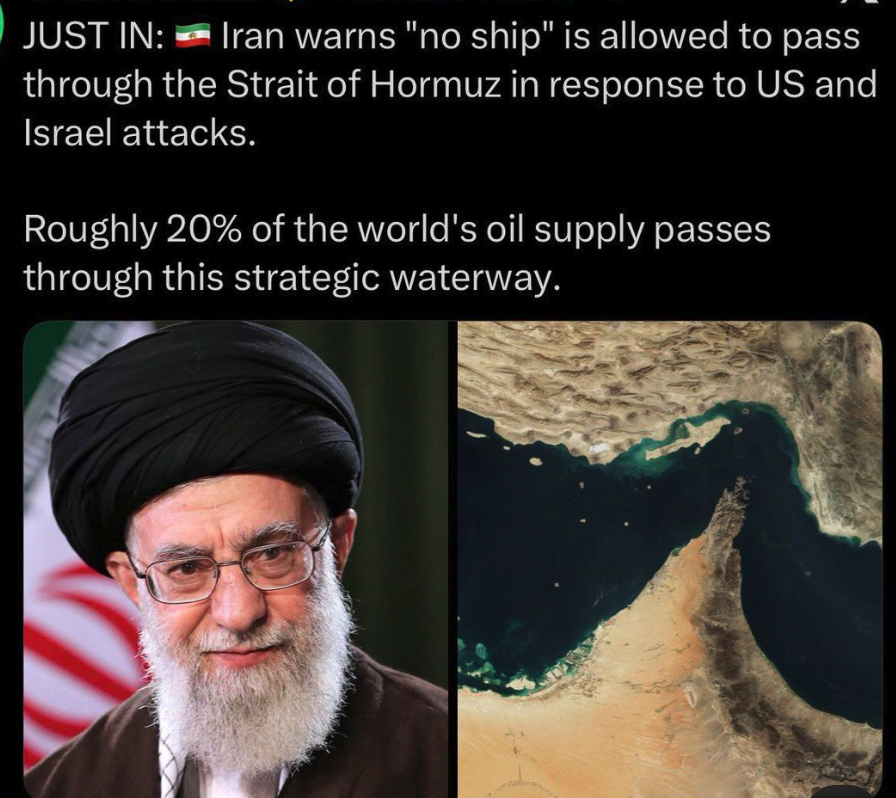
The latest market-moving headline is as blunt as it gets: Iran is now being reported as warning that no ship should pass through the Strait of Hormuz in response to US and Israeli attacks. That single sentence has the power to fundamentally alter how global markets operate.
Hormuz: More Than a Chokepoint, A Global Pressure Valve
This is not merely another Middle East headline; it represents one of the few geopolitical developments capable of simultaneously impacting nearly every major asset class. The Strait of Hormuz is far from a symbolic chokepoint. It’s a central pressure valve for the global energy and shipping systems, facilitating the passage of roughly a fifth of the world’s oil, a significant portion of Gulf LNG exports, and crucial regional trade traffic. If traders perceive passage as insecure, a comprehensive repricing begins long before any official declaration of closure.
Markets don’t require a signed legal notice to declare the strait shut. Instead, they simply need the waterway to become too risky, too expensive, too uncertain, or too uninsurable for normal operations. In practice, a credible threat, a missile, a drone, a boarding attempt, an explicit mine warning, or even a compelling radio message can initiate a rapid repricing cycle. And crucially, that cycle has already begun, as reflected in the emerging market dynamics around oil price live and LNG prices Gulf.
Unpacking the Multi-Asset Market Impact
The latest reporting suggests that ships have received warnings, some vessels have altered their courses, insurers are actively reassessing war-risk exposure, and fresh maritime advisories are urging operators to avoid the area where possible. This matters profoundly because the distinction between an open strait and a non-functioning one isn't always about a physical blockage. Often, it's simply a case of widespread unwillingness to bear the escalating risk. A de jure closure would be historical, but a de facto closure can inflict similarly violent consequences on market prices, forcing a reassessment of safe haven assets and global economic stability.
Energy Markets on Edge
Oil would move first, setting the tone for everything else. If Hormuz is compromised, Brent crude and WTI cease to trade purely on supply-demand fundamentals and instead become wartime insurance contracts. The initial response would be an aggressive geopolitical risk premium embedded in front-month crude. Subsequently, the market would scrutinize the curve; if near-term barrels become difficult to guarantee, prompt contracts could surge more dramatically than deferred ones. Products like diesel, jet fuel, and bunker fuel would likely follow suit, as transport and refining logistics immediately enter the risk equation. This highlights why the oil price spike war is a primary concern. The crude oil price live feed will be closely watched. The Brent crude surge and WTI crude rally are clear indicators of this escalating risk. Furthermore, the natural gas price live and LNG prices Gulf will see substantial impact.
Gold and Forex as Barometers of Fear
Gold would almost certainly benefit, serving as the purest liquid hedge in a market suddenly grappling with war, inflation risk, central-bank uncertainty, and institutional instability. Silver would likely follow, though with increased volatility due to its dual role as a growth barometer. Should this develop into a prolonged standoff, gold can outperform silver, given its role as the cleaner fear hedge. Conversely, the US dollar safe haven status typically strengthens in such scenarios, alongside the Swiss franc war trade and the Japanese yen war trade, illustrating a flight to safety. The forex war analysis will be critical for understanding immediate and longer-term currency movements, including how the EUR USD realtime and EUR to USD live rate will react.
Equities, Credit, and Crypto Reactions
The impact on equities would be nuanced, not a uniform decline. Energy producers, defense names, and some gold miners would likely see rallies, while sectors like airlines, tourism, and consumer discretionary would be severely impacted. Gulf markets crash risk is a genuine concern, with Gulf bank stocks and property-related names particularly vulnerable. Credit markets would act as a truth detector; a rise in oil credit spreads would signal a systemic funding stress beyond a mere event risk. For crypto, the initial reaction would likely be a de-risking phase driven by liquidity concerns, where Bitcoin Trades Near $65,742 Amid Macro Liquidity Shifts become secondary to broader risk-off sentiment. Later, large crypto assets might recover if the event ignites debates about alternative payment rails or reserve diversification.
The Long-Term Implications: Inflation and Policy
The Hormuz threat creates a classic macro conflict for interest rates: rising oil and fuel costs push inflation expectations higher, while tighter financial conditions and geopolitical stress weigh on growth. This push-pull generates significant rates volatility, forcing bond markets to differentiate between an inflation shock, a growth shock, or a stagflation signal. A war-driven energy spike threatens to delay or complicate central banks' plans for rate cuts, even if the broader economy shows signs of weakening. This situation also brings to the forefront the critical discussion of global commodities war analysis and shipping stocks war in this evolving landscape.
Operational vs. Headline Shock: A Critical Distinction
It is vital for the market to distinguish between a headline shock and an operational shock. A headline shock causes price jumps due to fears of disruption, which we are currently observing. This is evidenced by the Iran warns no ship allowed Hormuz and Iran US war news today. An operational shock occurs when ships actively stop, insurers withdraw coverage, cargoes are rerouted, and inventories are drawn down significantly. The former is chaotic; the latter is historic. The market is aggressively trying to ascertain whether it remains in the first stage or is about to cross into the second. This story is so dangerous because it perfectly encapsulates the intersection of war, energy, shipping, inflation, and financial confidence, affecting crude oil trading and the overall market map.
Once the Strait of Hormuz enters the market's consciousness as an actively contested channel, oil is no longer merely oil, shipping is no longer simply shipping, and Gulf assets are no longer priced as if the region's commercial architecture exists outside of immediate conflict. This is the inherent message embedded in the 'no ship allowed' pronouncement.