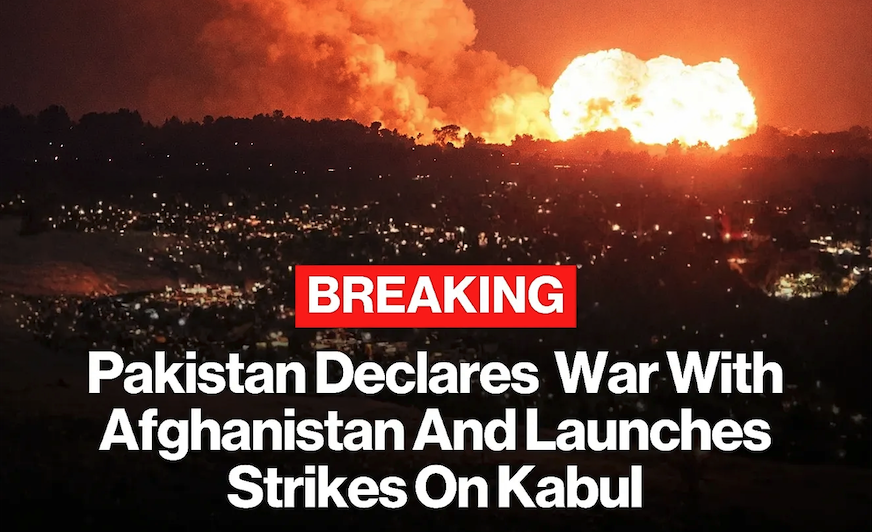
A dramatic escalation this week saw Pakistan declare open war with Afghanistan, launching military strikes on Afghan targets including Kabul. While a major regional event in its own right, this new conflict erupts amidst the already tense Iran-US-Israel war cycle, creating a dangerous ‘second front shock’ that significantly amplifies risks across global markets. The crucial focus keyword, "Pakistan Afghanistan Iran crisis market risks," encapsulates this widening geopolitical concern, and its immediate implications are already being felt in commodity and currency markets.
The Changing Geopolitical Map and Market Perception
Markets do not merely price isolated battlefields; they price evolving geopolitical maps. The ignition of open conflict between Pakistan and Afghanistan, a direct consequence of cross-border attacks and retaliatory strikes, transforms a series of localized tensions into a profound regional security deterioration. This means investors are no longer confronting a single war centered on Iran but a potential unraveling of stability across the entire belt from the Eastern Mediterranean to South Asia. This broader instability alters how traders perceive risks for oil, shipping, safe-haven assets, emerging-market currencies, defense spending, and even airline routes, demanding a recalculation of regional stability premiums. It's a much bigger macro event than any isolated conflict.
Oil and Gold: The Bellwethers of Regional Stress
Oil markets are invariably the first to react to regional stress. While a Pakistan-Afghanistan war does not directly threaten the Strait of Hormuz, its eruption during the Iran-US-Israel war cycle reinforces the narrative that the entire neighborhood is transitioning from tension to fragmentation. This keeps a significant geopolitical premium embedded in Brent crude and WTI, making it harder for traders to dismiss the Iran conflict as a contained Gulf issue. Instead, it becomes part of a larger instability complex affecting energy routes and military logistics, influencing both the Crude Oil Trading: Geopolitical Risk & Key Levels Ahead and the broader outlook.
Gold, in turn, benefits from this pervasive uncertainty. It acts not just as a hedge against direct battlefield risk but against cascading geopolitical disorder and potential institutional failures when multiple crises converge. A Pakistan-Afghanistan escalation, layered onto the ongoing Iran crisis, strengthens the safe-haven argument for gold, even if its direct correlation to a specific chokepoint like Hormuz is less pronounced compared to oil. Traders are actively monitoring the Gold Price: Analyzing Weekend Settlement & Next Week's Risk Map in this evolving environment.
Forex and Emerging Markets: Second-Order Effects
The forex market will express the second-order effects of this widening conflict most clearly. The initial reaction to a broader conflict map typically involves a flight to safety, strengthening the US dollar, Swiss franc, and Japanese yen. Beyond these core safe-havens, emerging-market currencies face increasing pressure, particularly those with fragile external balances, high energy import exposure, or a reliance on stable capital inflows. High-carry trades become more vulnerable, volatility rises, and funding becomes more selective. For instance, the NZDJPY Volatility: Navigating Policy Divergence and Key Levels Next Week, or the CHFJPY Volatility: Navigating Policy Divergence and Key Levels Next Week, demonstrate the sensitivity of carry currencies to these broader shifts. The USDCHF Outlook Today: Navigating Volatility and Key Levels, which currently sees USDCHF price live, reflecting immediate tactical flows. For Pakistan itself, the financial implications are severe, with questions arising over fiscal strain, defense spending, and currency confidence.
Broader Market Implications and Sectoral Impact
The expansion of the conflict map profoundly impacts a multitude of sectors including defense and aerospace industries. Investors anticipate longer procurement cycles, increased regional defense spending, enhanced air-defense demand, and larger security budgets from states feeling increasingly exposed. Consequently, defense stocks are poised for potential outperformance. Shipping and logistics, while not directly witnessing Gulf closures, will contend with regional trade uncertainty, higher insurance costs, and altered overland routes. Airlines and travel sectors also face the ripple effects of increased fuel costs, rising premiums, and dampened passenger sentiment due to overlapping conflict zones that hinder efficient movement. Equity markets will likely exhibit dispersion, with energy and defense outperforming, while tourism-sensitive names and sectors reliant on cheap logistics underperform. This necessitates vigilance on breadth and sector rotation, rather than solely focusing on general index levels. For instance, an EURCHF price live update will confirm how policy divergence contributes to FX market dynamics, and EURCHF price live rates impact cross-border trade.
Reading the Signals: Credit Markets and Crypto
Credit markets serve as a critical truth detector in this scenario. If crude prices remain elevated, gold strengthens, and credit spreads begin to widen in vulnerable emerging-market or transport-linked areas, this indicates a systemic shift in instability. Conversely, if credit remains composed, traders suggest the situation is alarming but not yet a structural financial event. This distinction is vital because while geopolitical headlines can trigger immediate movements in spot markets, credit markets reveal the economic durability of these shifts. Regarding digital assets, the initial phase of a widening conflict usually sees risk reduction dominating, leading to dollar strength and pressure on leveraged crypto positions. An EUR to CHF live rate is currently trading around 0.965 with an EUR CHF chart live showing recent volatility. The EUR CHF live chart indicates consolidation. The EUR CHF realtime feed confirms the tight trading range. However, if the narrative evolves to encompass sanctions, regional fragmentation, or alternative payment rails, the role of crypto could change. This EUR/CHF price live analysis reveals how broader market sentiment affects the pair, with the EURCHF price live data showing traders navigating current challenges. However, for now, managing risk remains the primary driver, impacting assets like EUR CHF price.
Conclusion: A Recalculation of Regional Risk
The critical takeaway from Pakistan's open conflict with Afghanistan, occurring simultaneously with the broader Iran-US crisis, is not merely about a direct military connection. It fundamentally alters the market's perception of regional stability. This "Pakistan Afghanistan Iran crisis market risks" scenario tells investors that the area surrounding the Iran war is becoming less stable, presenting a wider arc of insecurity stretching into South Asia. This confluence of events forces every market participant to recalculate just how localized these crises truly are, increasing the perceived probability of miscalculation and broader regional contagion.