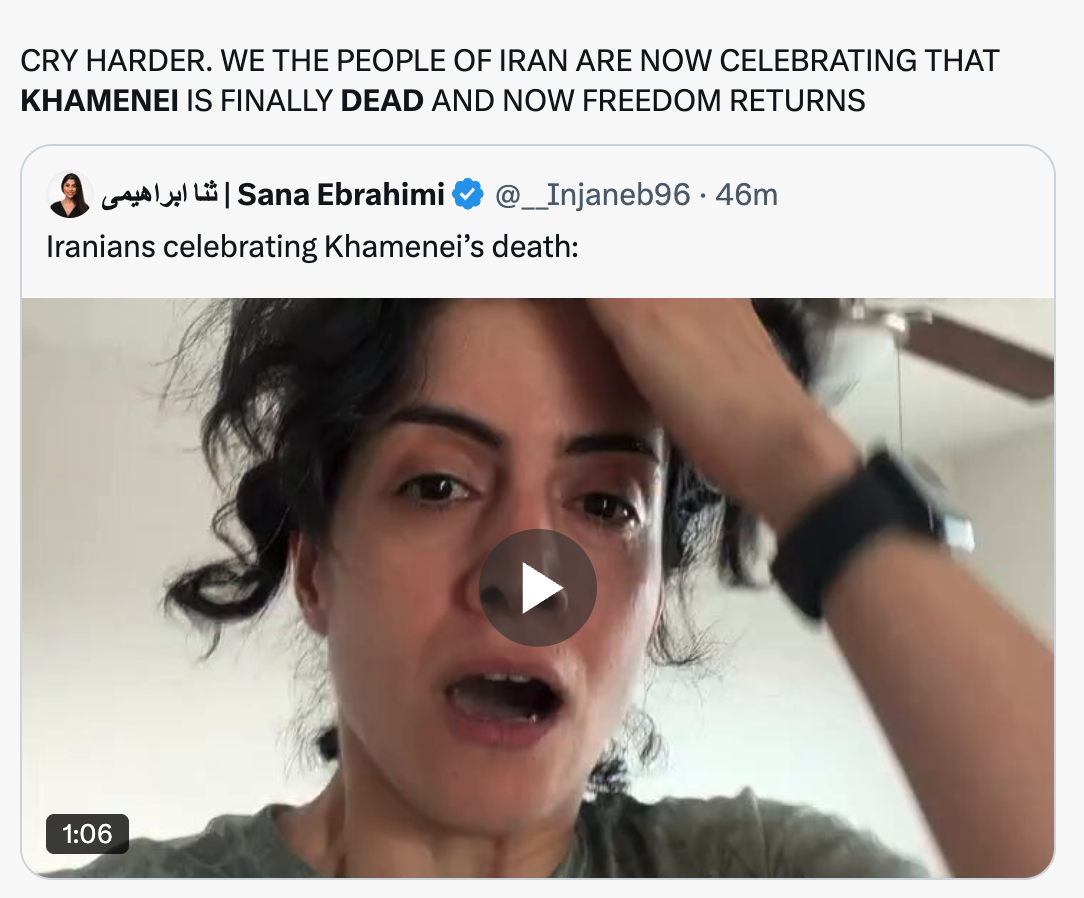
The latest development in the unfolding Iran narrative transcends simple geopolitical tensions; it's the widespread circulation of videos depicting Iranians celebrating the possible death of Ayatollah Ali Khamenei. These powerful images are transforming the market's assessment from a conventional war story to a deeper, more profound regime-shock event, with potentially explosive consequences across global financial markets.
While a missile strike, even one of historic proportions, typically triggers a predictable market response centered on oil and safe-havens, the emergence of celebration footage changes the fundamental framing. It signals to traders that the situation might no longer be solely about retaliation, crude oil price, or military action. Instead, it suggests that the political center of gravity within Iran could be fracturing in clear public view. This introduces a completely different, and far more volatile, trading thesis.
From War-Pricing to Regime-Pricing: A Paradigm Shift
Markets are inherently forward-looking and rarely wait for perfect certainty. Instead, they price in the most plausible future scenarios. The initial reaction to news concerning the Supreme Leader, whether from official sources or social media, has been met with conflicting signals. Trump has notably declared Khamenei dead, and Israeli officials have suggested a successful strike. Countering this, Tehran has pushed back, avoiding the stabilizing transition sequence that global investors typically seek. This fluid and disputed event means that while war-pricing (oil up, gold price war, stocks down) is the immediate response, the appearance of celebration videos shifts the calculus dramatically.
Indeed, once images of celebration, whether originating from within Iran, from exile networks, or anti-regime channels, begin circulating, investors are compelled to ask a much broader question than merely the success of a strike. They start dissecting: if the supreme leader is truly gone, what then happens to the intricate system that has held the Islamic Republic together? This leads to the real repricing, a shift towards what we call regime-pricing, where the stability and continuity of the state itself are scrutinized. The phrase Khamenei dead regime shock directly encapsulates this critical market dynamic.
Khamenei's Central Role and Market Implications
Ayatollah Khamenei was no ordinary official; he was the linchpin of Iran's entire political, religious, and security apparatus. He unified the clerical establishment, the Revolutionary Guards (IRGC), the judiciary, the state's narrative, and its foreign policy doctrine. His absence risks Iran not just losing a leader, but potentially its central coordinating force at a moment of direct military tension. When combined with public celebration, this transforms the event from an external strike against a unified regime into an external shock landing squarely on internal weakness. This is when markets move from predictable war-pricing to unpredictable regime-pricing, with far-reaching consequences.
Cross-Asset Impact of Regime-Pricing
The distinction between war-pricing and regime-pricing is immense. War-pricing follows a familiar template: higher oil prices, rising gold prices, weaker equities, and a flight to safe-haven currencies. However, regime-pricing forces investors to consider complex scenarios:
- Oil Markets: Crude oil price Iran news suggests that while initial surges are due to geopolitical risk, the added layer of regime instability implies a 'disorder premium.' A weakened command structure in Iran could make critical choke points like the Strait of Hormuz, Gulf shipping, and regional energy infrastructure far more vulnerable. Brent crude and WTI crude rally could reflect not just strategy, but unpredictable bursts of action or lack of control over proxies. Investors are evaluating the immediate impact on Crude Oil Trading: Geopolitical Risk.
- Gold and Safe Havens: Gold becomes an even stronger magnet, functioning not just as a traditional war hedge, but as a hedge against a breakdown of political continuity. A disputed leader-death story, especially one accompanied by celebration clips, drives investors towards clean, liquid assets detached from specific local institutions, reinforcing the demand for safe haven assets. Silver may follow, but gold is the purest expression of this regime-risk fear.
- Forex Markets: The initial FX movement favors classic risk-off plays into the US dollar, Swiss franc, and Japanese yen. However, a more complex map emerges. Oil exporters might gain some support from higher crude prices, while high-beta emerging-market currencies could suffer from heightened volatility. In pegged systems, such as many in the Gulf, stress might appear in sovereign spreads, CDS, local-equity weakness, and interbank caution rather than immediate spot FX moves. The impact on USDCHF outlook today and other major pairs is significant.
- Equity Markets: Equities would likely bifurcate. Energy, defense, and select commodity producers could benefit from higher prices and a geopolitical premium. Conversely, airline stocks war, travel, consumer cyclicals, and especially Gulf financial names would face significant pressure. This is because regional business models rely heavily on perceptions of stability, which a regime-rupture story directly undermines.
- Shipping and Insurance: The shipping stocks war narrative would intensify. If an 'unclean' escalation is anticipated post-Khamenei death, tankers, cargo, and insurers must price risks from proxy actions, maritime harassment, and fragmented command behavior, impacting the Strait of Hormuz latest dynamics.
- Aviation: Gulf aviation relies on safe, efficient movement. Perceived chaotic airspace risk could lead to reroutes, increased fuel and insurance costs, and depressed traveler sentiment, quickly impacting tourism and related economic activities.
- Credit Markets: Credit spreads become the ultimate barometer. Widening spreads, particularly in vulnerable sectors and regional issuers, signal that a military shock is evolving into a more dangerous confidence and funding shock.
- Crypto Markets: Crypto war risk typically leads to initial deleveraging and stronger dollar demand. However, if the narrative shifts to sanctions, capital flight, or state instability, the second-order effects could lead to a different dynamic for cryptocurrencies as alternative payment rails.
The Domestic Dimension: Weakening Fear Barriers
The videos of Iranians celebrating Khamenei death are not just symbolic; they suggest mass exhaustion with the regime. Iran, already grappling with inflation, currency weakness, and sanctions, could see fear barriers weaken. Markets understand that weakening fear barriers increase the probability of street unrest, crackdowns, defections, and institutional confusion. This is where the crisis expands beyond a conventional war scenario to a deeper, internal political collapse. The market is now acutely aware of Middle East conflict: no-deal talks and its effect on regional stability.
This is precisely why the celebration videos are so critical. Markets don't just react to missiles; they react to perceived legitimacy. When that legitimacy becomes publicly fragile, the financial repercussions extend far beyond Tehran, fundamentally altering the global market map. Investors are now closely watching indicators such as proof of life, formal succession signals, IRGC continuity, internet restrictions, proxy actions, and Gulf precautions to assess whether Iran is behaving as a unified state or a wounded system likely to trigger further Iran Israel war latest developments.