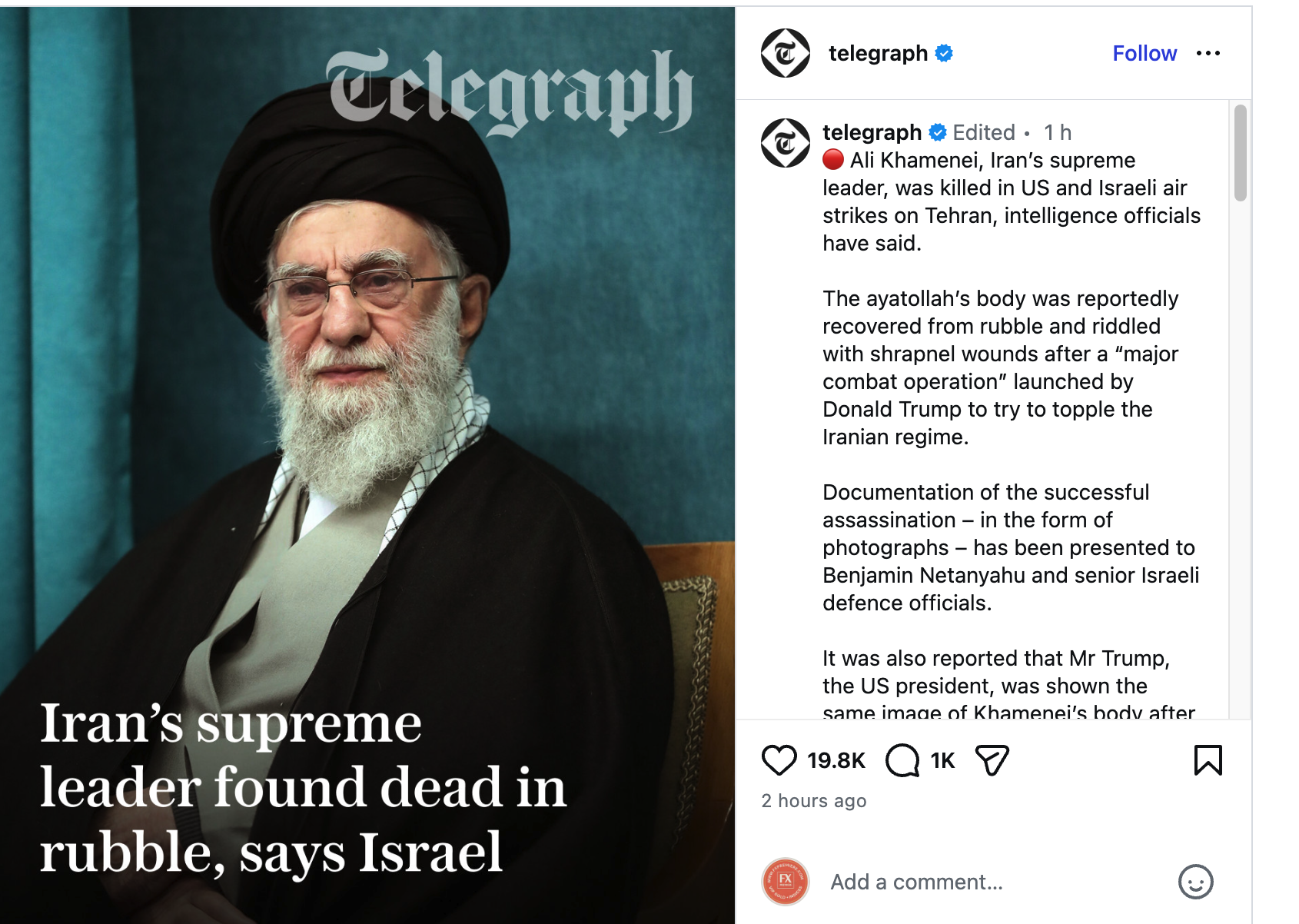
The latest, and most explosive, headline from the Middle East suggests Iran's Supreme Leader Ali Khamenei may have been found dead in rubble following recent US-Israeli strikes on Tehran. This development, if confirmed, fundamentally alters the market's assessment of regional geopolitical risks, moving beyond standard wartime anxieties to encompass a full-blown regime-shock scenario, which could trigger an Iran succession crisis.
While previous reports speculated on Khamenei's demise, the current narrative of his body being recovered from the rubble after an apparent 'decapitation strike' introduces a new layer of urgency and profound uncertainty. Up until now, global markets have been grappling with a broad wartime framework, characterized by missile exchanges, threats to Gulf energy infrastructure, and general fear premium. However, the potential removal of Iran's top leader by external forces would shift the focus from war escalation to the much larger macro event of regime disruption.
Regime Shock vs. Conflict Escalation: A Critical Market Distinction
A typical war headline drives predictable responses: an increase in crude oil price, a surge in gold price, heightened shipping risk, and a flight to safe-haven currencies. A leadership-confirmation headline, especially one involving a 'decapitation strike', forces markets to price in a more complex array of variables. These include succession dynamics, the continuity of command, internal regime control, proxy activation strategies, potential public reaction within Iran, and the overarching possibility of less disciplined, more chaotic retaliation. This crucial distinction matters significantly for investors, as markets generally cope with conflict better than with profound uncertainty over who holds power.
If reports of Khamenei’s death and the recovery of his body are accurate, the critical question transitions from 'what Iran does next' to 'who decides what Iran does next.' This is the point where the real market shock begins. Khamenei was the central node of the Iranian system, integrating the clerical establishment, the Revolutionary Guards, ideological narratives, state security, and regional strategy. His removal during active hostilities compels markets to assign probabilities to multiple dangerous outcomes:
- Orderly succession
- Hardline consolidation by the Revolutionary Guards
- Internal power struggles between religious and military factions
- Public unrest and challenges to the regime's legitimacy
- Rapid, potentially overzealous, proxy retaliation
- Command confusion leading to unpredictable responses
Each of these scenarios carries substantially different market ramifications. For instance, the Strait of Hormuz latest news regarding potential disruptions could further exacerbate the geopolitical impact on energy markets.
Asset Class Repricing: Beyond Just Oil and Gold
While crude oil will be the first market to react intensively, the situation extends beyond a simple oil story. The primary driver for a significant crude oil spike would be the escalated probability of miscalculation around the Strait of Hormuz, Gulf shipping lanes, and energy infrastructure due to a fractured command structure. Brent crude surge and WTI crude war scenarios don't require actual supply loss to rally sharply; the fear premium alone could suffice. For those tracking the energy sector, knowing the current Brent crude and WTI crude price is paramount.
Gold would remain a prime beneficiary. Beyond being a hedge against war, gold is a direct hedge against political rupture and uncertainty over state continuity. This makes it incredibly relevant in the current context. Investors should closely monitor XAUUSD price live as it reflects immediate safe-haven demand. Silver could follow, but gold, tracked as gold price live, is the cleaner safe-haven trade if succession chaos and retaliation risk escalate into a systemic breakdown, potentially affecting other safe haven assets.
Forex markets would see layered movements. The initial reaction involves a standard flight into the US dollar, Swiss franc, and Japanese yen. However, differentiation would quickly emerge. Emerging-market currencies with weak external balances could face intense pressure. Oil-linked currencies might initially gain from a crude spike but could lose ground if the crisis impacts global growth. In the Gulf, repricing pressure wouldn't necessarily appear in headline FX due to pegs but in sovereign risk, CDS, local equities, and bank funding. Keeping an eye on USDCHF price live and other major pairs allows for tracking macro shifts.
Equities would almost certainly experience violent rotation. Energy and defense sectors would likely outperform, alongside gold miners and select commodity exposures. Conversely, airlines, logistics, consumer cyclicals, tourism-linked stocks, and Gulf financials could face severe headwinds. Any sector reliant on smooth regional movement, predictable fuel costs, business confidence, or a compressed geopolitical premium would be vulnerable to a new Iran breaking news today headline. Stock market war news could dominate headlines.
Wider Economic Implications and the Role of Credit Markets
The impact extends to banking and property sectors in the Gulf, which heavily rely on confidence. A leader-decapitation event could trigger fears of wider instability, leading to higher risk premiums for banks and questions about capital inflows and sentiment for developers. Credit markets will serve as a truth detector; while oil price Iran war concerns drive energy markets, widening credit spreads, especially among vulnerable regional issuers, would signal a broader confidence and funding shock rather than just a single military event.
Rates markets would grapple with an exacerbated war-growth-inflation conflict. Higher oil prices would fuel inflation expectations, while increased uncertainty would tighten financial conditions and weigh on growth. This could lead to safe-haven buying in Treasuries initially, combined with rising rates volatility as traders reprice both inflation and recession risks simultaneously, creating unstable central bank expectations.
Crypto markets would likely experience an initial de-risking phase, where leveraged positions are cut and the dollar strengthens. However, if the narrative shifts towards sanctions, capital flight, alternative payment rails, and long-term geopolitical fragmentation, this trend could reverse. Many monitor the crypto war risk implications.
The domestic Iran angle is critical. If Khamenei is confirmed dead, and the public perceives it as such, the regime faces an internal legitimacy test in an active war. Public protests or challenges to the regime's narrative could signal a volatile transition rather than a controlled succession, presenting one of the most significant geopolitical shocks of the decade. This would mean that Iran is entering a succession crisis that could deeply impact regional stability and global markets. The distinction between a stable and a disorderly post-Khamenei transition is enormous.
The 'found in rubble' phrasing takes the story from mere speculation to apparent physical confirmation. Markets rarely wait for official confirmation; they trade on probabilities. The crucial signals going forward will include any proof-of-life or formal acknowledgment from Tehran, visible chain-of-command continuity, statements from the Revolutionary Guards, succession choreography, public reaction in Iran, proxy activities, Hormuz shipping behavior, and Gulf state security postures. These clues will determine whether this becomes a contained shock or a full regime-risk repricing with broader implications for global risk assets.