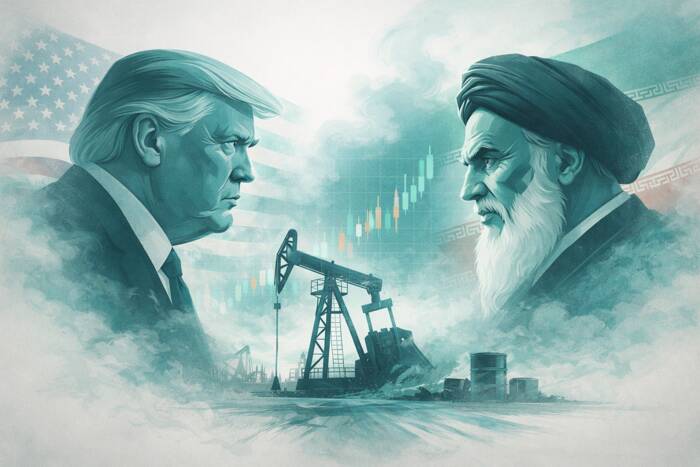
The Iran war has unequivocally transformed from a localized military exchange into a battle with profound global economic implications. Recent developments, including direct hits on Iranian oil infrastructure, attacks on embassies in Oslo and Baghdad, and civilian casualties from missile debris in Dubai, signal an expanded theater of conflict. This escalation necessitates a fundamental re-evaluation of risk and pricing models across every asset class, propelling markets to factor in a global conflict premium.
The War's Escalation: A New Economic Phase
The critical shift overnight is not merely the continuation of hostilities, but a drastic change in the target set. For the first time, Iran's internal oil infrastructure has been directly struck, leading to fuel spills and urban fires in Tehran. Simultaneously, the conflict’s geographic reach has broadened, evidenced by an explosive device at the US Embassy in Oslo and a missile hitting the US Embassy in Baghdad's Green Zone. Civilian fatalities from intercepted missile debris in Dubai and drone strikes reported in Kuwait further underscore the pervasive spread of risk. This situation is no longer a contained military skirmish; it is an economic infrastructure conflict with far-reaching consequences for international diplomacy and global trade. The market is now pricing in realization, not just probabilistic tail risks.
The most immediate and profound impact is on energy markets. When an oil depot burns and fuel distribution systems are targeted, traders immediately shift their focus beyond military hardware to assess implications for spare storage, refinery uptime, urban panic effects, and crucially, insurance exclusions. This transition marks the moment a war ceases to be a mere geopolitical headline and becomes a macro transmission mechanism. Oil is reacting because the operational reliability of energy flows is explicitly under attack. This heightens direct infrastructure vulnerability and worsens operational assumptions for carriers. Crude Oil Price Action Amid Iran War & Grid Stress is now a primary driver, with the market assuming a broadened retaliation logic and increased duration risk, ensuring oil maintains a geopolitical premium even without a full Strait of Hormuz blockade.
Oil and Gas: The Immediate Impact
While the focus remains largely on crude oil, the next significant macro problem could emerge from natural gas and LNG expectations. The Gulf region is a linchpin for global LNG cargoes and refined fuel linkages. Should traders conclude that Gulf infrastructure remains exposed, airport and air-defense stress persists, and commercial routing becomes slower, then confidence in continuous LNG delivery weakens. This is particularly critical for Europe, where energy security remains fragile, and Asia, which relies heavily on Gulf flows. Therefore, even without an official export shutdown, gas futures are prone to increased instability as the market doubts overall reliability. For those tracking Crude Oil CL=F: Iran War Jitters & Next-Week Risk Map, these dynamics are crucial. We are seeing both Natural Gas Soars 4.23%, Geopolitical Risks Drive NG=F and Natural Gas Futures: Navigating Key Levels Amid Geopolitical Jitters playing out prominently.
Gold: The Ultimate Regime Hedge
In times when markets lose faith in clear policy sequencing, gold becomes a crucial hedge. This scenario is precisely what’s unfolding. Investors are now questioning the prolonged elevation of oil prices, potential delays in central bank rate cuts, and the pervasive rise in shipping and insurance costs. Gold thrives on this confluence of inflation risk, geopolitical risk, and policy uncertainty, acting as a hedge against a world where these factors move in tandem. This explains why the gold price war bid can remain strong even with intermittent equity stabilization. The XAUUSD price live chart reflects this persistent demand.
Forex: A Dispersion Story
The initial reaction in forex is typical: the dollar benefits from risk aversion, funding demand, and portfolio defensiveness. The Swiss franc finds support, and the yen sees classic safe-haven flows, though persistent energy stress complicates its trajectory. However, the deeper forex narrative reveals a dispersion story. As oil infrastructure burns and political signaling from Tehran becomes inconsistent, currencies begin to price not just fear, but divergence. Oil importers face weakening currencies, high-carry FX becomes more fragile, and countries with weaker external balances appear more exposed. The EUR to USD live rate and other major pairs reflect the shifting risk appetite. The euro dollar live market is increasingly volatile, and the EURUSD price live data will continue to be closely watched. Investors are closely monitoring the EURUSD price live and the EUR USD chart live for signs of further economic impact.
Equities: Deeper Rotation Underway
While an initial sell-off across equities is common, this situation primarily triggers a significant sector rotation. Relative winners include energy, defense, air defense, missile interception suppliers, cybersecurity firms, and gold/commodity-linked exposures. Conversely, airlines, travel, tourism, Gulf property proxies, consumer discretionary names sensitive to energy and freight inflation, and industrials dependent on reliable shipping are likely to underperform. The key takeaway is that headline index stability can mask underlying weakness across various sectors. The focus now is on stock market war impact on specific sectors rather than a broad market collapse.
Rates: War as an Inflation Shock
The rates market is confronting conflicting forces: risk-off sentiment pushes yields lower, while elevated oil prices and infrastructure risks drive inflation expectations higher. This creates unstable trading conditions, as investors grapple with whether this is predominantly a growth scare or an inflation scare. Increasingly, it appears to be both – a challenging scenario for policymakers. If oil and shipping costs rise while growth confidence wanes, central banks face limitations in effectively supporting the economy. A multi-week conflict premium integrated into transport, fuel, insurance, and consumer expectations cannot be easily overlooked. This makes the war a critical factor for Treasury traders, not just energy traders.
Credit: Economic Pressure on Balance Sheets
Credit markets serve as an indicator of whether the war is translating into tangible balance-sheet costs. Watch for widening high-yield spreads, underperformance in airline and shipping credit, stress in regional banks, and broader sovereign spreads in exposed Gulf and nearby countries. More expensive funding for entities reliant on trade corridors or commodity logistics would confirm that the conflict is moving beyond emotional headline risk to impact the cost of capital. Once the war influences the cost of capital, it begins to tighten financial conditions independently of central bank actions.
Shipping and Insurance: The Quiet Inflation Engine
Perhaps the most underappreciated aspect of this crisis is its effect on shipping and insurance. When oil depots burn and missile debris causes civilian deaths in commercial hubs, insurers escalate war-risk premiums and redefine zones of insurable normality. This dramatically affects shipping: owners hesitate, routes become slower, freight costs rise, and refined product movements become less efficient. The ultimate burden falls on consumers, airlines, factories, and governments. Geopolitical instability often impacts wallets through insurance and logistics long before it solely affects headline crude prices. The escalating shipping insurance Gulf war costs are a direct reflection of this. Markets are also closely watching XAUUSD realtime data for immediate reactions to geopolitical news.
Crypto: Not Immune to Macro Impacts
While some crypto traders might advocate for Bitcoin as an ultimate hedge or predict a complete market collapse during risk-off periods, the reality is more nuanced. In the initial phase of a widening geopolitical shock, Bitcoin and other major crypto assets remain susceptible to global liquidity, leverage, and macro risk appetite. A strengthening dollar, rising rates volatility, investor deleveraging, or portfolio managers selling liquid assets to cover losses elsewhere can easily impact crypto valuations. While crypto could regain its hedge narrative if the conflict deepens into a broader confidence shock against fiat systems or leads to capital controls, the immediate response is heavily driven by liquidity, not ideology. The EUR USD realtime movements, alongside crypto market shifts, highlight the current interconnectedness.
The Broader Diplomatic and Economic Signals
The Oslo embassy incident, despite its limited military impact, is significant because it signals the diplomatic footprint of the war extending into Europe. This increases security risk perception, political pressure on European governments, and the likelihood that European assets will more directly trade the war. Similarly, the contradiction between Iran's public apologies to Gulf neighbors and continued strikes undermines the credibility of diplomatic language as a stabilizer. Such inconsistencies raise concerns about leadership divisions or operational synchronization issues, all of which imply a fatter risk premium for markets. We anticipate continued volatility for the EURUSD realtime charts, as well as the EURUSD price live data reflecting ongoing uncertainty.
Key Signals to Watch
Investors should closely monitor several key indicators: further hits on oil or refinery-linked assets, additional embassy incidents across Europe, expansion of damage to Gulf airport and fuel infrastructure, whether oil establishes a higher price floor, tightening shipping insurance, signs of fracture or coherence in Iran's leadership, continued targeting of economic assets by the US and Israel, and sharp widening of credit spreads. These signals will determine if the conflict truly shifts into a sustained economic warfare phase.
Final Market Read: A Global Repricing
This is not just another escalation. The conflict has directly impacted critical economic and urban infrastructure, forcing markets to price it as an economic infrastructure conflict rather than merely a military confrontation. This ensures sustained oil support, a persistent gold geopolitical bid, a firm dollar, elevated shipping and insurance costs, a more complex inflation problem for central banks, intense equity rotation, and increased selectivity in credit markets. The war's pricing is now global, extending far beyond its initial regional confines. Traders will be looking at the EURUSD live chart and other key indices to gauge sustained impact.