
Economic Calendar for Gold Trading: CPI, FOMC, NFP and How to Manage News Volatility
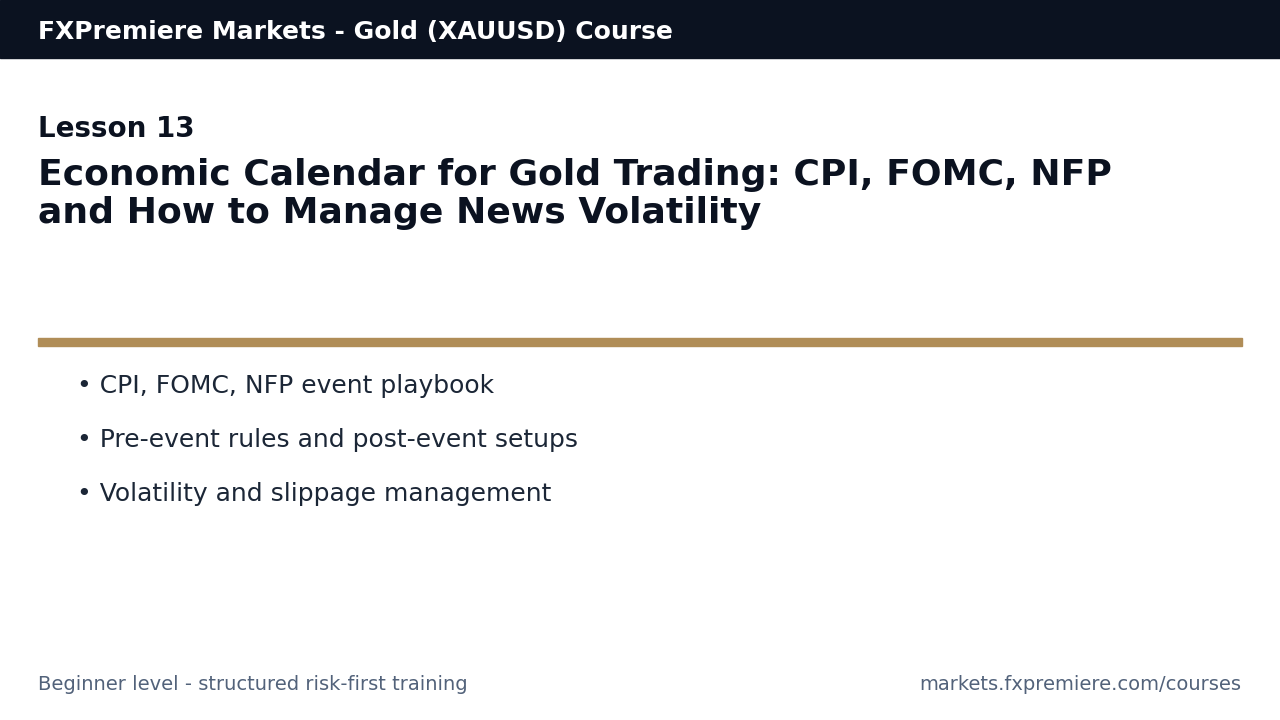
Lesson 13 in our gold trading course: Economic Calendar for Gold Trading: CPI, FOMC, NFP and How to Manage News Volatility. Beginner-friendly XAUUSD traini
Economic Calendar for Gold Trading: CPI, FOMC, NFP and How to Manage News Volatility
Executive summary
The economic calendar is a volatility map. Gold often reacts sharply to CPI, FOMC, and NFP. You will learn when not to enter, how to manage positions into events, and why post-news structure can be cleaner for beginners.Learning objectives
- Identify events that matter (CPI, FOMC, NFP)
- Build an event-risk policy
- Use post-news structure tactics
Institutional workflow
News workflow: mark releases -> avoid pre-event entries -> wait for first move -> trade post-news structure.Core lesson
The economic calendar is a volatility map. Gold often reacts sharply to CPI, FOMC, and NFP.
You will learn when not to enter, how to manage positions into events, and why post-news structure can be cleaner for beginners.
Professional note
Your edge as a beginner is executing a simple plan with consistent risk. Reduce mistakes first. Profit is a byproduct.Practical example (quick)
- Identify the level or condition
- Wait for confirmation on your trading timeframe
- Define stop at structural invalidation
- Size from stop
- Execute and journal in R
Concept deep dive
The economic calendar is where gold traders earn or lose months of progress in one candle. CPI, FOMC, and NFP can shift rate expectations instantly, creating sharp repricing and stop cascades. For beginners, the safest approach is to treat top-tier events as "no fresh entries" windows unless your plan is specifically designed for them.Event risk policy has three parts: 1) Entry restrictions (when you will not open new trades) 2) Position management (reduce size, take partials, or exit) 3) Post-event tactics (trade the structure after the first move)
The post-event "second move" is often cleaner because the first spike is dominated by positioning and liquidity. After the first move, levels become visible again.
Worked example
FOMC is in 45 minutes. You see a setup. The plan does not include event trading. You skip it. After the decision, gold spikes, then pulls back to a clear level. You wait for a 15m reclaim and enter with defined risk. That is discipline, not fear.Rules
- No new trades 30 to 60 minutes before top-tier releases.
- Expect slippage and widen spreads around events.
- Trade after structure returns, not during chaos.
Glossary
- Top-tier event: release that can change rates narrative (CPI, FOMC, NFP).
- Repricing: rapid adjustment to new information.
Implementation worksheet
Event playbook: before and after CPI
Before- No new trades 60 minutes pre-release
- Reduce open risk or take partials
- Accept that spreads and slippage can expand
After
- Wait for the first impulse move to finish
- Identify the first clear level formed post-release
- Trade the reclaim/retest with defined stop and reduced size if volatility is extreme
Mini exercise
Replay one CPI day on chart history. Mark:- First impulse
- First retrace
- Best post-news entry area
Checklist you can use today
- Calendar checked and event risk understood
- Levels or conditions defined before entry
- Stop-loss placed at structural invalidation
- Position size calculated from stop distance (risk in dollars)
- Order type chosen intentionally (market/limit/stop) and bracketed
- Trade logged in journal with R risk and plan notes
Common mistakes to avoid
- Entering right before CPI/FOMC/NFP, tight stops in spikes, revenge trading news.
FAQ
Q: Which news events matter most for gold?A: CPI, FOMC, and NFP are top-tier.
Q: Should I trade during news?
A: Only if tested. Beginners often do better after the first spike.
Q: What is the second move?
A: A follow-through or reversal after the first reaction, often cleaner.
More questions beginners ask
Q: Is it better to trade before or after CPI?A: Beginners often do better after. Pre-event entries can be stopped by volatility even if direction is right.
Q: How wide should my stop be during news?
A: Stops should still be structural, but volatility is higher. Many traders reduce size or avoid trading the spike.
Q: What is a news fade?
A: When the first reaction reverses. Beginners should avoid fading unless they have a tested plan.
Advanced beginner notes
A news plan is not about predicting the number. It is about controlling exposure.The event ladder
- Top-tier (CPI, FOMC, NFP): strict entry restrictions, expect slippage
- Medium-tier (PMIs, retail sales): moderate restrictions
- Low-tier: usually normal trading
Post-event entry types
- Retest of the first post-event level
- Break and hold with a pullback entry
- Range formation after volatility compresses
Beginners should prefer retests because they provide clearer invalidation and better sizing control.
Quick quiz
- What is the main decision framework taught in Lesson 13?
- What is one checklist item you must follow before every trade?
- What is the most common mistake highlighted in this lesson?
- What is one practical task you can complete today to apply this lesson?
Practical assignment
- Apply the workflow to a fresh chart review (no trading required).
- Write a 5-line summary in your journal focused on rules, not predictions.
- Save one screenshot that shows your levels/plan/order structure.
Key takeaways
- Trade a process, not a feeling.
- Define risk before you define reward.
- Repeat simple rules until they become automatic.
Related Guides
Advanced Roadmap: From Trader to Operator - Scaling Size, Playbooks, and Specialization
Advanced gold trading lesson 20: Advanced Roadmap: From Trader to Operator - Scaling Size, Playbooks, and Specialization. Institutional XAUUSD frameworks,
Stress Testing and Survival: Tail Events, Gaps, Platform Risk, and Contingencies
Advanced gold trading lesson 19: Stress Testing and Survival: Tail Events, Gaps, Platform Risk, and Contingencies. Institutional XAUUSD frameworks, regimes
Psychology for Advanced Traders: Pressure, Decision Quality, and Anti-Tilt Systems
Advanced gold trading lesson 18: Psychology for Advanced Traders: Pressure, Decision Quality, and Anti-Tilt Systems. Institutional XAUUSD frameworks, regim
Performance Engineering: Attribution, Error Taxonomy, and Process KPIs That Scale
Advanced gold trading lesson 17: Performance Engineering: Attribution, Error Taxonomy, and Process KPIs That Scale. Institutional XAUUSD frameworks, regime