
Gold Price Action Trading: The Candlestick Patterns That Matter (And How to Avoid False Signals)
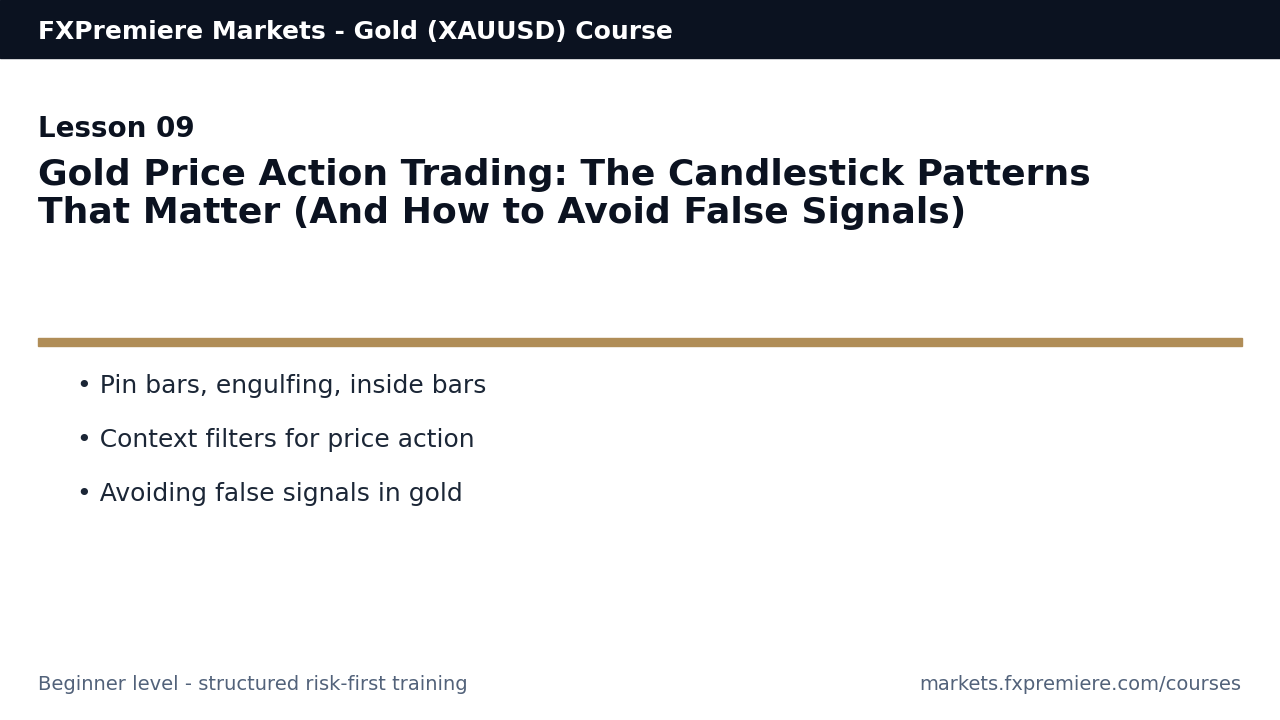
Lesson 9 in our gold trading course: Gold Price Action Trading: The Candlestick Patterns That Matter (And How to Avoid False Signals). Beginner-friendly XA
Gold Price Action Trading: The Candlestick Patterns That Matter (And How to Avoid False Signals)
Executive summary
Price action is a language. Candlestick patterns only matter when they appear at the right place and time. We cover pin bars, engulfing candles, inside bars, breakout closes, and doji. You will learn context filters that reduce false signals in XAUUSD.Learning objectives
- Use price action patterns only with level and trend context
- Filter false signals and avoid pattern collecting
- Define A+ criteria for entries
Institutional workflow
Price action workflow: level -> trend -> confirmation -> stop beyond structure -> target next level -> journal.Core lesson
Price action is a language. Candlestick patterns only matter when they appear at the right place and time.
We cover pin bars, engulfing candles, inside bars, breakout closes, and doji. You will learn context filters that reduce false signals in XAUUSD.
Professional note
Your edge as a beginner is executing a simple plan with consistent risk. Reduce mistakes first. Profit is a byproduct.Practical example (quick)
- Identify the level or condition
- Wait for confirmation on your trading timeframe
- Define stop at structural invalidation
- Size from stop
- Execute and journal in R
Concept deep dive
Price action is often marketed as "patterns." In practice, institutions care about location and response. The pattern is just a visible representation of response. A pin bar at a random place is noise. A pin bar rejecting a weekly zone after an extended move is information.For beginner price action in gold, focus on three ingredients: 1) Location: at a weekly/daily zone or clear range boundary 2) Context: trend alignment or clear exhaustion at extremes 3) Confirmation: close behavior, reclaim, or micro-structure turn
Gold is prone to wicks. That is why close behavior matters. A wick through a level is not the same as a close beyond a level.
Worked example
Gold sells into a daily support zone. A long lower wick forms (rejection) and the candle closes back above support. You do not buy immediately. You wait for the next 1H candle to hold above the zone, then enter with a stop under the wick low. Your target is mid-range or the next resistance zone. You used location, response, and confirmation instead of pattern worship.Pattern filters
- Only take patterns at pre-defined levels.
- Require a close that supports your bias.
- Skip signals during top-tier event windows unless you have a plan.
Glossary
- Rejection: failure to continue through a level.
- Confirmation: evidence the market accepted your level as support/resistance.
Implementation worksheet
Pattern-context matrix
Before you use any candle pattern, answer:- Is it at a weekly/daily zone?
- Is it aligned with daily bias?
- Is it during liquid session hours?
- Is there a top-tier event soon?
Only when most answers are yes does the pattern matter.
Two pattern drills
1) Collect 10 examples of rejection at a daily zone. Screenshot and label: level, rejection, invalidation, target. 2) Collect 10 examples where the same pattern failed. Label why: wrong location, wrong regime, event risk, or no confirmation.This teaches you what not to trade, which is as valuable as what to trade.
Checklist you can use today
- Calendar checked and event risk understood
- Levels or conditions defined before entry
- Stop-loss placed at structural invalidation
- Position size calculated from stop distance (risk in dollars)
- Order type chosen intentionally (market/limit/stop) and bracketed
- Trade logged in journal with R risk and plan notes
Common mistakes to avoid
- Trading patterns without levels, treating doji as signal, chasing candles.
FAQ
Q: Do candlestick patterns work for gold trading?A: Best at key levels with trend context. Alone, they are weak.
Q: What pattern is most useful for beginners?
A: Rejection (pin bar) at a real level with clear invalidation.
Q: How do I reduce false signals?
A: Require location, context, and confirmation.
More questions beginners ask
Q: Do candlestick patterns work on all timeframes?A: They can appear everywhere, but they are only meaningful when aligned with context and location. Higher timeframes are often cleaner.
Q: What is the best confirmation for a rejection candle?
A: A follow-through candle that holds the level, or a micro-structure turn on your execution timeframe.
Q: Should I trade every pin bar I see?
A: No. Trade only the ones at pre-defined zones with clear invalidation and target logic.
Worked trade walkthrough
Scenario: gold is in an uptrend on daily and pulls back into a daily demand zone. On 1H you see a rejection candle with a close back above the zone.- Entry: buy on the next 1H candle if price holds above the rejection close
- Stop-loss: below the rejection wick low, plus a small buffer
- Target: first at 1R to reduce pressure, main at 2R or next daily resistance
Risk control example: Account risk: $50 Stop distance: $5.00 If your broker value is $100 per $1 move at 1.00 lot, then 1.00 lot risk is $500. Size = 50/500 = 0.10 lots.
The point: the pattern gives you structure for invalidation. The sizing gives you consistency.
Quick quiz
- What is the main decision framework taught in Lesson 9?
- What is one checklist item you must follow before every trade?
- What is the most common mistake highlighted in this lesson?
- What is one practical task you can complete today to apply this lesson?
Practical assignment
- Apply the workflow to a fresh chart review (no trading required).
- Write a 5-line summary in your journal focused on rules, not predictions.
- Save one screenshot that shows your levels/plan/order structure.
Key takeaways
- Trade a process, not a feeling.
- Define risk before you define reward.
- Repeat simple rules until they become automatic.
Related Guides
Advanced Roadmap: From Trader to Operator - Scaling Size, Playbooks, and Specialization
Advanced gold trading lesson 20: Advanced Roadmap: From Trader to Operator - Scaling Size, Playbooks, and Specialization. Institutional XAUUSD frameworks,
Stress Testing and Survival: Tail Events, Gaps, Platform Risk, and Contingencies
Advanced gold trading lesson 19: Stress Testing and Survival: Tail Events, Gaps, Platform Risk, and Contingencies. Institutional XAUUSD frameworks, regimes
Psychology for Advanced Traders: Pressure, Decision Quality, and Anti-Tilt Systems
Advanced gold trading lesson 18: Psychology for Advanced Traders: Pressure, Decision Quality, and Anti-Tilt Systems. Institutional XAUUSD frameworks, regim
Performance Engineering: Attribution, Error Taxonomy, and Process KPIs That Scale
Advanced gold trading lesson 17: Performance Engineering: Attribution, Error Taxonomy, and Process KPIs That Scale. Institutional XAUUSD frameworks, regime