
Start Trading Gold in 30 Days: Final Checklist, Common Mistakes, and Next Steps After This Course
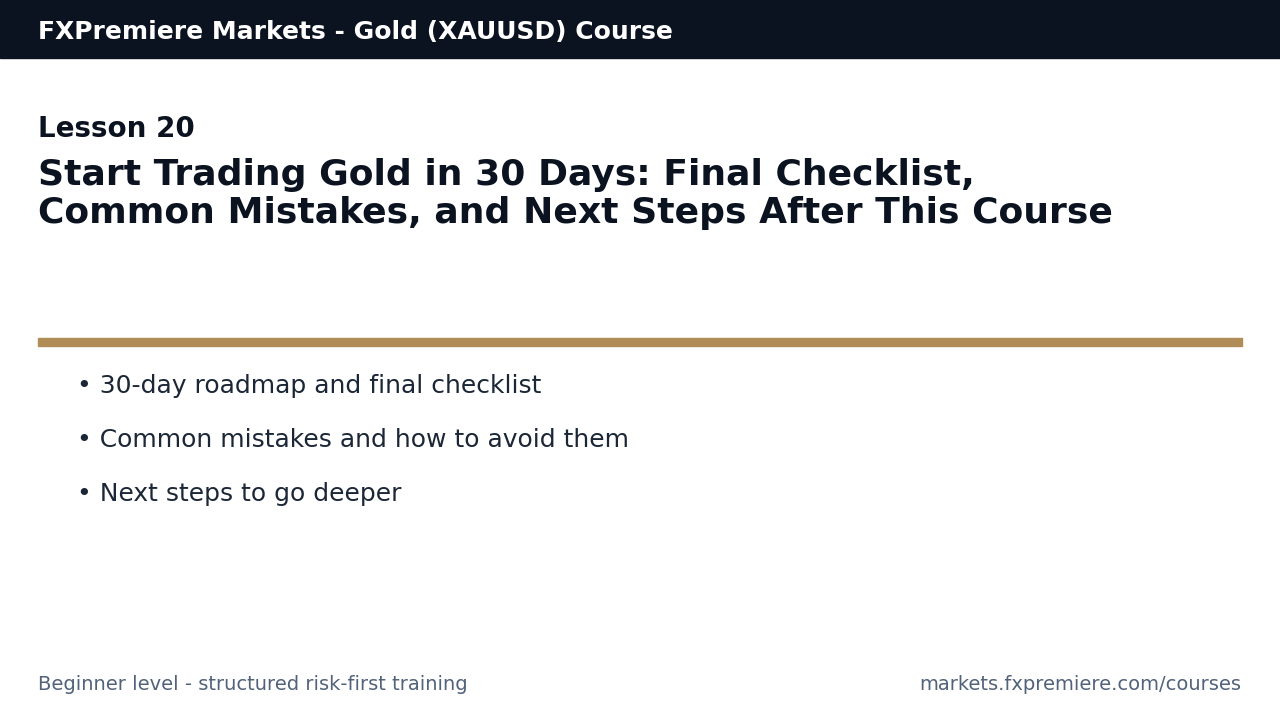
Lesson 20 in our gold trading course: Start Trading Gold in 30 Days: Final Checklist, Common Mistakes, and Next Steps After This Course. Beginner-friendly
Start Trading Gold in 30 Days: Final Checklist, Common Mistakes, and Next Steps After This Course
Executive summary
Final lesson: a complete 30-day plan, daily checklist, common mistakes, and next steps after you finish the beginner phase.Learning objectives
- Follow a 30-day roadmap and daily checklist
- Avoid common beginner mistakes
- Choose the next learning step with clarity
Institutional workflow
Launch workflow: 30-day plan -> daily checklist -> weekly review -> scale only after consistency.Core lesson
Final lesson: a complete 30-day plan, daily checklist, common mistakes, and next steps after you finish the beginner phase.
Professional note
Your edge as a beginner is executing a simple plan with consistent risk. Reduce mistakes first. Profit is a byproduct.Practical example (quick)
- Identify the level or condition
- Wait for confirmation on your trading timeframe
- Define stop at structural invalidation
- Size from stop
- Execute and journal in R
Concept deep dive
This is your launch plan. The goal is not to "win big." The goal is to build a professional routine, consistent sizing, and a repeatable strategy.The 30-day structure
Days 1-7: Foundations- Build chart template and level drawing routine
- Learn order types and practice bracket orders on demo
- Lock risk per trade and daily loss cap
- Journal even if you do not trade
Days 8-14: Strategy selection
- Choose System A (trend) or System B (range) based on daily regime
- Backtest 10 to 15 examples
- Start demo trading only that system
Days 15-21: Execution
- Trade only A+ setups
- Measure results in R
- Identify your top two execution errors
Days 22-30: Review and tighten
- Weekly review with plan vs break tagging
- Reduce mistake rate
- Decide if you repeat another month on demo or go live very small
Final pre-flight checklist
- I know my daily bias and key levels
- I know the next top-tier event time
- I have a complete trade plan (entry/stop/target/invalidation)
- My position size is computed from stop distance
- I am within daily risk limits and open risk limits
- I will journal the trade whether it wins or loses
Common mistakes (and the fix)
- Trading too often: limit trades per day and require A+ criteria
- Changing strategy: commit for 30 trades minimum
- Oversizing: reduce risk and survive long enough to learn
- Ignoring events: respect CPI/FOMC/NFP windows
Glossary
- A+ setup: setup that meets all your rules with no compromises.
- Routine: repeatable daily process that prevents impulsive decisions.
Implementation worksheet
30-day daily checklist (print this)
- Calendar checked
- Weekly/daily zones marked
- Regime classified
- One allowed strategy selected
- Risk limits confirmed
- Plan written before entry
- Size computed from stop
- Journal updated after trade
Go-live criteria (minimum)
- 30 demo trades executed with your rules
- Mistake rate below 20%
- You can explain your plan in one minute
- You accept small losses without changing size
If you meet these, go live with the smallest size possible. If not, repeat another month on demo. Speed is not the point.
Checklist you can use today
- Calendar checked and event risk understood
- Levels or conditions defined before entry
- Stop-loss placed at structural invalidation
- Position size calculated from stop distance (risk in dollars)
- Order type chosen intentionally (market/limit/stop) and bracketed
- Trade logged in journal with R risk and plan notes
Common mistakes to avoid
- Scaling size too early, chasing every move, ignoring A+ criteria.
FAQ
Q: Can I start with a small account?A: Yes if you can size correctly. If minimum lots force large risk, stay demo.
Q: Fastest way to improve?
A: Execute one strategy, journal every trade, review weekly.
Q: What should I learn next?
A: Advanced structure, positioning, options context, and regimes.
More questions beginners ask
Q: What if I finish the course but still feel unsure?A: Repeat the routine for another month on demo. Confidence is built by repetition and review.
Q: Should I trade gold every day?
A: No. Trade only when your setups appear. A professional can have many no-trade days.
Q: What is the best next step after this course?
A: Pick one strategy, backtest it, forward test it, and add complexity only after consistency.
Advanced beginner notes
The beginner phase ends when you can follow rules consistently, not when you have a big winning week.Weekly milestones
Week 1: levels, routine, and risk policy locked Week 2: one strategy chosen, 10 to 15 backtests logged Week 3: demo trading with strict checklists, no overtrading Week 4: weekly review and tightening, decide demo repeat vs micro-liveMicro-live step
If you go live, reduce risk to the smallest possible size for two weeks. Your goal is to test psychology, not to maximize returns. Many traders fail because they jump from demo confidence to live emotions too quickly.Quick quiz
- What is the main decision framework taught in Lesson 20?
- What is one checklist item you must follow before every trade?
- What is the most common mistake highlighted in this lesson?
- What is one practical task you can complete today to apply this lesson?
Practical assignment
- Apply the workflow to a fresh chart review (no trading required).
- Write a 5-line summary in your journal focused on rules, not predictions.
- Save one screenshot that shows your levels/plan/order structure.
Key takeaways
- Trade a process, not a feeling.
- Define risk before you define reward.
- Repeat simple rules until they become automatic.
Related Guides

Advanced Roadmap: From Trader to Operator - Scaling Size, Playbooks, and Specialization
Advanced gold trading lesson 20: Advanced Roadmap: From Trader to Operator - Scaling Size, Playbooks, and Specialization. Institutional XAUUSD frameworks,
Stress Testing and Survival: Tail Events, Gaps, Platform Risk, and Contingencies
Advanced gold trading lesson 19: Stress Testing and Survival: Tail Events, Gaps, Platform Risk, and Contingencies. Institutional XAUUSD frameworks, regimes
Psychology for Advanced Traders: Pressure, Decision Quality, and Anti-Tilt Systems
Advanced gold trading lesson 18: Psychology for Advanced Traders: Pressure, Decision Quality, and Anti-Tilt Systems. Institutional XAUUSD frameworks, regim
Performance Engineering: Attribution, Error Taxonomy, and Process KPIs That Scale
Advanced gold trading lesson 17: Performance Engineering: Attribution, Error Taxonomy, and Process KPIs That Scale. Institutional XAUUSD frameworks, regime