
Trading Psychology for Gold Beginners: FOMO, Revenge Trading, Overtrading and a Daily Routine
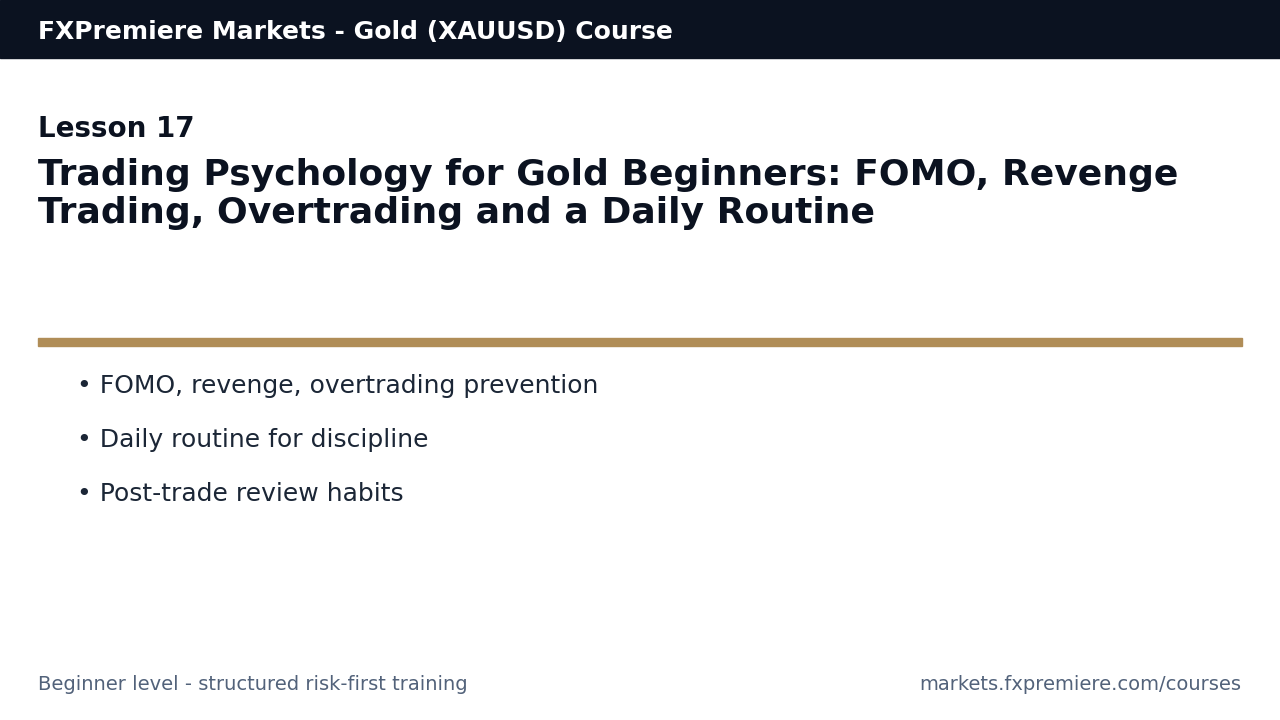
Lesson 17 in our gold trading course: Trading Psychology for Gold Beginners: FOMO, Revenge Trading, Overtrading and a Daily Routine. Beginner-friendly XAUU
Trading Psychology for Gold Beginners: FOMO, Revenge Trading, Overtrading and a Daily Routine
Executive summary
Psychology is a performance problem. Gold is fast enough to trigger FOMO, revenge trading, and overtrading. You will build a pre-trade checklist, daily routine, and post-trade routine that improves discipline and learning.Learning objectives
- Recognize FOMO, revenge, and boredom trading
- Adopt a daily routine and checklists
- Journal objectively and reduce mistakes
Institutional workflow
Psychology workflow: pre-trade checklist -> limit trades -> stop after daily loss -> review mistakes not outcomes.Core lesson
Psychology is a performance problem. Gold is fast enough to trigger FOMO, revenge trading, and overtrading.
You will build a pre-trade checklist, daily routine, and post-trade routine that improves discipline and learning.
Professional note
Your edge as a beginner is executing a simple plan with consistent risk. Reduce mistakes first. Profit is a byproduct.Practical example (quick)
- Identify the level or condition
- Wait for confirmation on your trading timeframe
- Define stop at structural invalidation
- Size from stop
- Execute and journal in R
Concept deep dive
Trading psychology is operational. You are not trying to become emotionless. You are building a system that prevents emotions from reaching the order button.The main traps in gold:
- FOMO after a breakout candle
- Revenge trading after a stop-out
- Overtrading in chop to feel productive
- Anchoring to a bias even after invalidation
Institutions reduce these errors through rules, limits, and supervision. You can replicate supervision with checklists and hard limits (daily loss cap, max trades per day).
Worked example
You lose one trade and immediately see another setup. You feel urgency. Your checklist asks: "Is this A+ or is this me trying to recover?" If it is recovery, you stop. That single pause is a professional habit.Daily discipline routine
- Pre-session: calendar, levels, bias, allowed strategy, risk limits
- In-session: only A+ setups, max trades per day, stop after daily loss cap
- Post-session: journal, screenshot, one improvement for tomorrow
Glossary
- FOMO: fear of missing out, chasing movement.
- Revenge trading: trying to win back losses quickly.
Implementation worksheet
The psychology kill-switch protocol
If you notice any of these:- urge to double size
- urge to "get it back"
- entering without writing plan
Reflection prompts (2 minutes)
- What emotion is driving the urge?
- What rule would protect me right now?
- What is the smallest constructive action I can take (review, walk, reset)?
Mini exercise
Create a one-line rule you can read out loud before every trade. Example: "If I cannot define invalidation, I cannot trade."Checklist you can use today
- Calendar checked and event risk understood
- Levels or conditions defined before entry
- Stop-loss placed at structural invalidation
- Position size calculated from stop distance (risk in dollars)
- Order type chosen intentionally (market/limit/stop) and bracketed
- Trade logged in journal with R risk and plan notes
Common mistakes to avoid
- Trading tired/stressed, trying to win back losses, skipping checklists.
FAQ
Q: How do I stop overtrading?A: Limit daily trades and use a checklist that blocks low-quality setups.
Q: What is revenge trading?
A: Trying to win back losses quickly by lowering standards or increasing size.
Q: How do I build discipline?
A: Routine and checklists. Motivation is unreliable.
More questions beginners ask
Q: Why is gold trading so emotional?A: Because gold moves fast and the PnL swings can be large if sizing is wrong. Risk control reduces emotional load.
Q: What is the best anti-FOMO rule?
A: No entry after a large impulse candle unless it is part of your tested plan. Wait for pullback and confirmation.
Q: How do I recover after a bad day?
A: Stop trading, review mistakes, and return with smaller risk and stricter filtering.
Advanced beginner notes
Discipline is an environment, not a personality.Environment design
- Trade in a fixed window
- Disable one-click trading if it makes impulsive entries easier
- Use alerts so you are not tempted to "manufacture" trades
- Keep a written max trades per day rule visible
The mental stop
Before every entry, pause for 10 seconds and answer:- Is this in my plan?
- Is risk defined and sized?
- Would I take this trade if my last trade was a win?
If the answer is no, you do not trade. That pause is how professionals avoid tilt.
Worked trade walkthrough
Scenario: you miss a breakout and feel urgency to chase.Professional routine:
- You write: "missed trade" in journal, no entry
- You wait for pullback or a new setup at a level
- You keep risk unchanged
A simple rule that prevents damage: "If entry is not in plan, I cannot trade it."
Over a month, this single rule can remove many low-quality trades that come from emotion rather than structure.
Quick quiz
- What is the main decision framework taught in Lesson 17?
- What is one checklist item you must follow before every trade?
- What is the most common mistake highlighted in this lesson?
- What is one practical task you can complete today to apply this lesson?
Practical assignment
- Apply the workflow to a fresh chart review (no trading required).
- Write a 5-line summary in your journal focused on rules, not predictions.
- Save one screenshot that shows your levels/plan/order structure.
Key takeaways
- Trade a process, not a feeling.
- Define risk before you define reward.
- Repeat simple rules until they become automatic.
Related Guides
Advanced Roadmap: From Trader to Operator - Scaling Size, Playbooks, and Specialization
Advanced gold trading lesson 20: Advanced Roadmap: From Trader to Operator - Scaling Size, Playbooks, and Specialization. Institutional XAUUSD frameworks,
Stress Testing and Survival: Tail Events, Gaps, Platform Risk, and Contingencies
Advanced gold trading lesson 19: Stress Testing and Survival: Tail Events, Gaps, Platform Risk, and Contingencies. Institutional XAUUSD frameworks, regimes
Psychology for Advanced Traders: Pressure, Decision Quality, and Anti-Tilt Systems
Advanced gold trading lesson 18: Psychology for Advanced Traders: Pressure, Decision Quality, and Anti-Tilt Systems. Institutional XAUUSD frameworks, regim
Performance Engineering: Attribution, Error Taxonomy, and Process KPIs That Scale
Advanced gold trading lesson 17: Performance Engineering: Attribution, Error Taxonomy, and Process KPIs That Scale. Institutional XAUUSD frameworks, regime