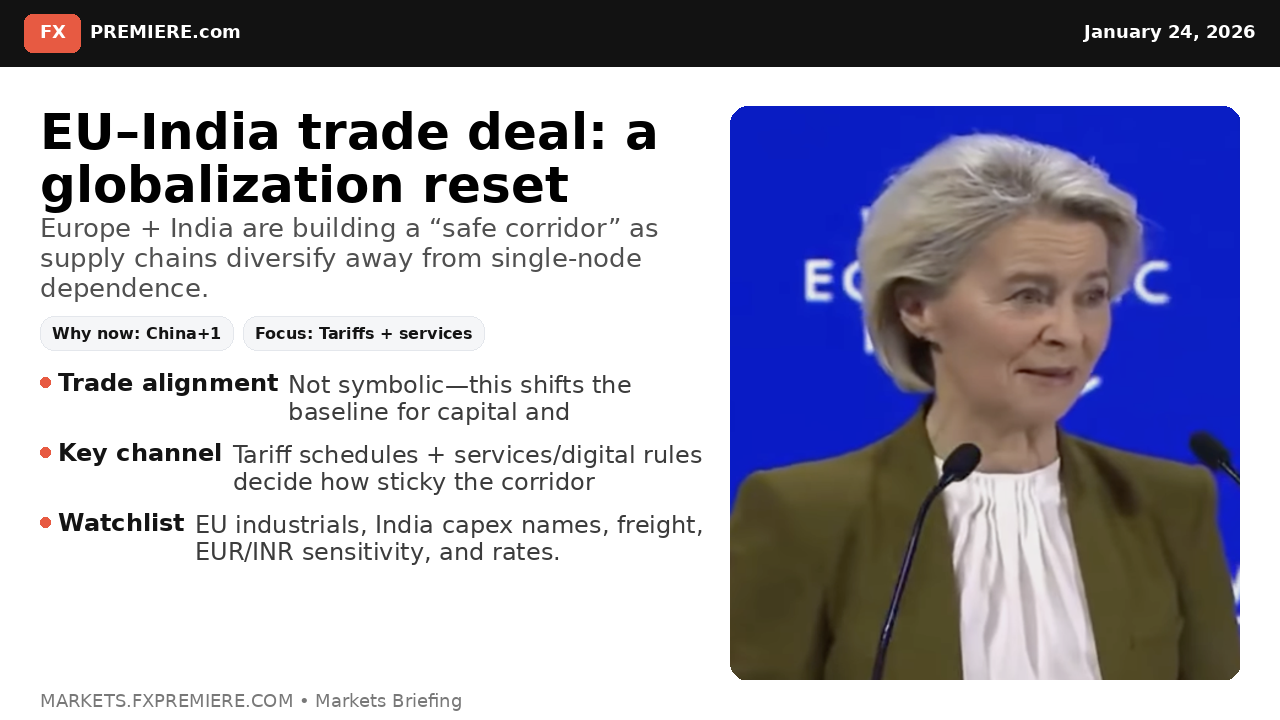
For years, the EU–India free trade agreement (FTA) was treated as a diplomatic elective—technically important but endlessly delayed. Today, it has transformed into a critical globalization reset, redrawing the map of global manufacturing and supply chain resilience in a post-trust era.
The Shift Toward Selective Globalization
The timing of the current EU-India negotiations serves as a major market signal. This is no longer just about reducing tariffs; it is about "selective globalization." As China concentration becomes a board-level risk, both blocs are aggressively seeking a "China+1" strategy to ensure supply chain redundancy that can withstand geopolitical shocks and export controls.
As protectionism rises globally, large economic blocs are locking in "safe corridors." This potential FTA represents a de-risking move disguised as a growth story, bringing together European capital and industrial depth with India’s massive demographic scale and consumption growth.
The Four Pillars of the 'Mother of All Deals'
Financial markets are closely monitoring four specific pillars that define this multi-decade strategic alignment:
1. Manufacturing Re-routing
Tariff structures in sectors such as autos, machinery, and chemicals will determine where the next marginal factory is built. For instance, in the EUR/USD and USD/INR spheres, the tariff schedule dictates the flow of physical goods and long-term infrastructure investment.
2. Services and Digital Trade
This is where the "quiet alpha" resides. Aligning regulatory frameworks for IT, finance, and legal services determines if the relationship can scale beyond simple commodities into high-value services. This is particularly relevant for regional hubs like Singapore; see our analysis on the STI Index Analysis for context on South Asian trade gates.
3. Clean Energy and Industrial Policy
A tightened cooperation on the electrification supply chain creates a structural boost to capex duration. Markets are beginning to price in a multi-year build cycle rather than just a one-off headline.
4. Strategic Autonomy in Pharma and Chips
Pharmaceuticals and semiconductors are now viewed as pillars of national resilience. Deeper industrial cooperation here enables both the EU and India to achieve greater sovereignty in critical technologies.
Cross-Asset Implications for Traders
The first impact of the deal is the repricing of probability distributions regarding location, political, and policy risks.
- Forex: EUR and INR sensitivity will rise. A credible corridor could compress Europe’s risk premium while boosting the Rupee through investment optimism. Related shifts often mirror those seen in other emerging markets; for example, see our USD/MXN Strategy for similar pivot behavior.
- Equities: European industrials and Indian logistics/infrastructure providers appear to be the primary narrative winners.
- Commodities: Increased manufacturing activity typically supports industrial metals. Traders should monitor the Copper Growth Proxy for real-time confirmation of industrial demand.
Barriers to Implementation
Two major hurdles remain: Carbon border measures and domestic politics in "hard sectors" like steel and autos. If the carbon rules act as a new tariff in disguise, the actual competitiveness gains for Indian exporters may be blunted. Similarly, if concessions in the auto sector are narrow, markets may treat the final announcement as "headline-positive but execution-negative."
Conclusion: A New Global Axis
The EU–India FTA is not about simple trade optimism; it is the formation of a new axis in the global economy. By aligning strategic demand with industrial depth, these two powers are building a credible alternative to single-node supply chains, signaling that the next phase of globalization will be built on aligned, resilient blocs.