
Pelosi Portfolio Disclosure: Trading Megacap Optionality in 2026
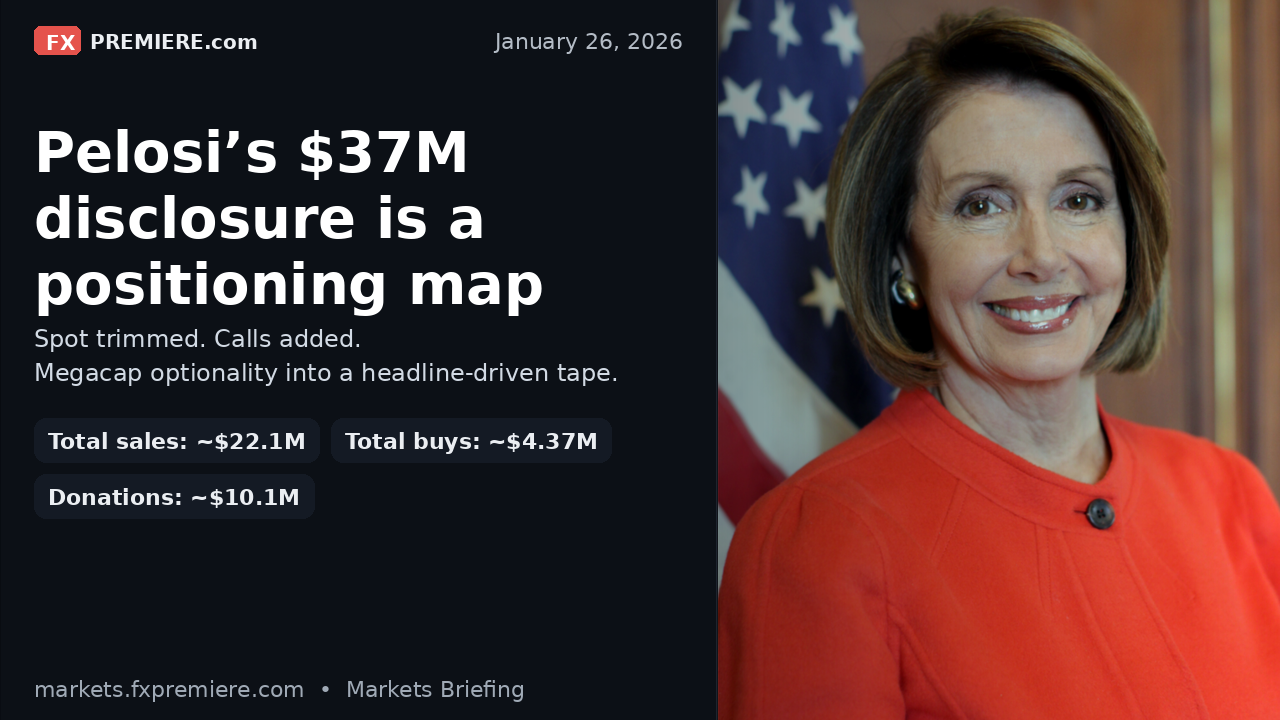
Analyzing the strategic shift in recent high-profile congressional disclosures: why 'spot down, convexity up' is the institutional playbook for 2026.
A high-profile congressional transaction report has just hit the tape, revealing roughly $37 million in activity across sales, call exercises, and strategic donations. While headlines often focus on the political figures involved, the real value for traders lies in the underlying portfolio structure, which provides a masterclass in managing megacap volatility.
Deconstructing the $37M Disclosure: Spot Down, Convexity Up
The disclosure indicates a sophisticated approach to risk management rather than a simple directional bet. Total sales reached approximately $22.1 million, primarily through trimming equity positions in Apple and Amazon. However, this was balanced by adding upside potential through call options and exercising existing ones. This strategy allows a portfolio to reduce delta exposure—minimizing drawdown pain—while maintaining participation in the 2026 AI narrative.
For those monitoring the AAPL price live, the sale of roughly $12.3 million in shares followed by new call purchases suggests a desire to stay "in the theme" without wearing full spot volatility. Similarly, the apple live chart reflects a market where investors are increasingly using options to define their downside. Traders following the AAPL chart live should note that such restructuring often points to a view that while the long-term trend remains intact, the immediate "path" may be violent.
The Megacap Battlefield: NVDA, AMZN, and GOOGL
The activity wasn't limited to a single ticker. Large-scale adjustments in NVIDIA and Alphabet show that the core battlefield remains focused on the infrastructure layer of the global economy. As the NVDA price live fluctuates, institutional-grade players are rolling structures to ensure they aren't caught in intraday gaps. Looking at the NVDA live chart, we see a regime where liquidity is deepest, making it the default arena for large capital allocations.
Traders utilizing the NVDA chart live for execution will recognize that the NVDA realtime data supports a "compute-driven" macro theme. In this context, the NVDA live rate is more than just a stock price; it is a barometer for the entire AI and data center stack. The disclosure also highlighted a pivot toward energy constraints, with call exercises in names like VST (Vistra), which ties directly into the power demand required for the next leg of innovation.
Strategic Concentration: Closing the Laggards
Another key takeaway from the filing is the complete exit from underperforming names like Disney (DIS) and PayPal (PYPL). This "book clean-up" signifies a move toward simplicity and concentration. When volatility rises, capital tends to retreat from complex or lagging stories and moves toward where narrative momentum is strongest. This is clearly visible when you analyze the AMZN price live performance compared to broader retail laggards.
The AMZN live chart shows a resilient infrastructure play, and the AMZN chart live patterns suggest that market participants prefer the safety of megacap balance sheets. With AMZN realtime data feeding into algorithmic strategies, the ability to maintain exposure via calls—as seen in the disclosure—is becoming the default expression for risk-aware traders. Keeping an eye on the AMZN live rate is essential for anyone trading the intersection of consumer demand and cloud growth.
The Alphabet Play: Exercising the View
Alphabet also featured prominently, with a mix of share donations and call exercises. For those tracking the GOOGL price live, the exercise of approximately $0.75 million in calls indicates a commitment to maintaining long-term exposure. The google live chart often mirrors the broader indices, and observing the GOOGL chart live can provide clues on institutional sentiment toward the "data layer" of AI. As GOOGL realtime volatility spikes, owning convexity via the options market remains a preferred tactic to survive the GOOGL live rate swings.
Practical Takeaways for 2026 Traders
This disclosure should not be treated as a front-run signal. Instead, it reflects a broader regime change: optionality is king. In 2026, the winners are not just those with the best stories, but those whose positions can survive a path filled with geopolitical headlines and macro shifts. By reducing spot equity and increasing call exposure, large portfolios are essentially saying: "We want to be long, but we won't pay for the volatility with our principal."
Related Reading:
Apple (AAPL) Q1 2026 Earnings Strategy: Trading the Revision Impulse
NVIDIA (NVDA) Earnings Strategy: Trading the Revision Impulse
Amazon (AMZN) Q4 Earnings Strategy: Trading the Flow and Guidance
Alphabet (GOOGL) Q4 Earnings Strategy: Trading the Post-Call Tape
Frequently Asked Questions
Related Analysis

Bitcoin Near $67k, Ether Near $1.9k Amid Macro Headwinds & Regulation
Bitcoin and Ether grapple with macroeconomic headwinds and regulatory uncertainty, as key economic data points and central bank policies drive market sentiment.

The Cost of Resilience: How Reshoring Drives Macro Shifts
Explore how policy-driven reshoring and stockpiling are subtly but significantly reshaping global supply chains, leading to higher unit costs and impacting financial markets, from manufacturing...

Sector Rotation: Why Quality Cyclicals Trump Duration in Sticky Rates
Dive into the current market dynamics where cash flow and balance-sheet strength are key, leading to a rotation favoring quality cyclicals over traditional duration plays amidst sticky interest...

Crypto Markets: Policy, Liquidity, and the Path to a Reset
Bitcoin and Ether prices are navigating elevated volatility as crypto markets reprice based on evolving policy and macroeconomic liquidity, rather than speculative hype. Unresolved stablecoin...